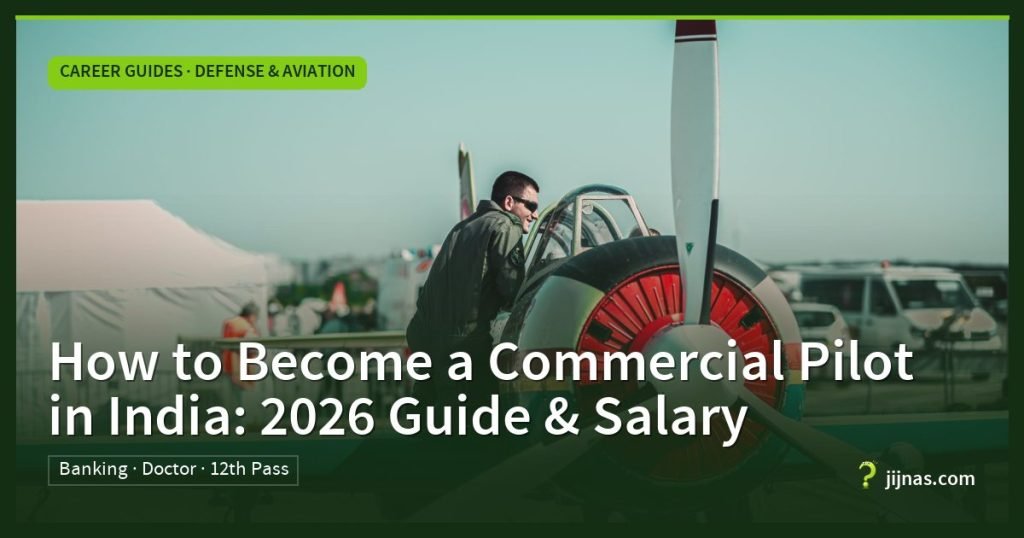
How to Become a Commercial Pilot in India: 2026 Guide & Salary
Learn how to become a commercial pilot in India. Check DGCA exam requirements, flying school costs, and salary details. Start your aviation career today!
- Starting salary
- ₹6-168 LPA a window, not a promise
- Entrance exams
- 4 DGCA Computer Number, DGCA Class 2 Medical Examination, DGCA Written Examinations
What Does a Commercial Pilot Actually Do?
A Commercial Pilot is a professional licensed by the Directorate General of Civil Aviation (DGCA) in India to fly aircraft for remuneration, ensuring passenger safety and efficient air travel. Your daily work revolves around meticulous flight preparation, strict safety procedures, and operating aircraft across domestic or international air routes.
A typical morning flight starts at 06:00 AM when you arrive at the airport, pass security, and report to the operations office. At 07:00 AM, you conduct a briefing with your crew, including the First Officer and cabin team, reviewing the flight plan, weather reports, fuel status, and special advisories. By 07:30 AM, you are in the cockpit conducting pre-flight checks, inspecting flight instruments, navigation hardware, and aircraft logs. Boarding completes by 08:30 AM, followed by engine start, taxi, and take-off. From 09:00 AM to 12:00 PM, you handle in-flight duties, monitor engine instruments, communicate with Air Traffic Control (ATC), and manage the flight path. Landing, taxiing to the gate, and post-flight engine shutdowns run from 12:00 PM to 01:00 PM. You finish the shift between 01:00 PM and 02:00 PM after debriefing your team and logging flight hours.
You use specialized tools daily, including flight instruments, navigation computers, communication radios, weather radar systems, and flight management software. You report directly to your airline flight operations department and duty flight captains while taking active directions from Air Traffic Control during flight. A good week means smooth clear-weather flights, punctuality, and seamless turnarounds. A bad week brings unexpected technical faults, severe monsoon weather diversions, flight cancellations, and irregular shift rosters that test your fatigue management skills.
Hour by hour
- 06:00 AMArrive at the airport, undergo security checks, and head to the operations office.
- 07:00 AMBrief with the crew on the flight plan, weather conditions, aircraft status, and special considerations.
- 07:30 AMPerform pre-flight checks in the cockpit, reviewing flight instruments, navigation systems, and logs.
- 08:30 AMComplete boarding, manage pushback, taxi, and execute take-off.
- 09:00 AM - 1Perform in-flight duties, monitor aircraft systems, communicate with ATC, and manage the flight path.
- 12:00 PM - 0Land the aircraft, taxi to the gate, and execute post-flight checks.
- 01:00 PM - 0Debrief with crew members, finish paperwork, and prepare for the next flight or layover.
Who Should Choose This?
Flying requires technical discipline, strong situational awareness, quick math skills under pressure, and physical stamina. Test your initial interest against these traits.
You should NOT choose this career if you prefer fixed office hours, get stressed by unexpected schedule changes, cannot maintain strict physical fitness standards, or are seeking a rapid low-cost financial return on your investment. Initial training requires heavy capital without guaranteed initial flight placements.
The Roadmap
- Complete 10+2 with Physics and Mathematics: Pass your Class 12 exams with Physics and Mathematics from a recognized board, or clear them through the National Institute of Open Schooling (NIOS).
- Obtain DGCA Computer Number: Apply online on the DGCA portal to receive your unique aviation candidate identification number required for all theoretical exams.
- Pass Medical Examinations: Clear the DGCA Class 2 medical evaluation with an empanelled doctor, followed by the stricter Class 1 medical examination at an authorized military medical boarding center.
- Complete CPL Ground School: Enroll in an aviation ground academy or flying school to study theoretical subjects including Air Regulations, Air Navigation, Aviation Meteorology, and Technical General.
- Clear DGCA Written Exams: Pass all DGCA theory modules and the Radio Telephony Restricted (RTR) exam conducted by the Wireless Planning and Coordination (WPC) wing.
- Accumulate Flight Hours: Log a minimum of 200 hours of flight training at a DGCA-approved Flying Training Organisation (FTO), covering solo flights, cross-country navigation, night flying, and instrument flying.
- Receive Commercial Pilot License (CPL): Submit flight logs, exam marks, and medical clearances to the DGCA to receive your official CPL.
- Complete Type Rating and Airline Hiring: Self-fund or enter a cadet program for a specific jet type rating (such as Airbus A320 or Boeing 737) and join an airline as a Trainee First Officer.
Start from where you are
The road is different from Class 9 than from a job. Pick your line; the page remembers it.
- Class 11-12Study Physics and Mathematics diligently.
These subjects are mandatory for CPL eligibility.
- After Class 12Obtain a DGCA Computer Number.
This unique aviation ID is mandatory for taking DGCA exams.
- After Class 12Undergo a Class 2 Medical examination.
This is the initial fitness assessment needed before starting flight training.
- After clearing Class 2 MedicalEnroll in a DGCA-approved Flying Training Organisation for ground classes.
Ground classes prepare you for mandatory DGCA theoretical written exams.
- During ground classesPass all DGCA written exams.
Passing these exams is required to obtain your license.
- After written exams and turning 18Obtain a Class 1 Medical Certificate.
This stricter medical assessment is required for CPL issuance.
- After ground classes and Class 1 MedicalComplete a minimum of 200 hours of flight time at an FTO.
Flight hours including solo, cross-country, night, and instrument flying are required for CPL.
Your immediate focus must be building a strong foundation in Mathematics and Science. Choose the Science stream with Physics, Chemistry, and Mathematics for your 11th and 12th standard. Work on building active English communication skills and physical health. You can apply for a DGCA Computer Number once you turn 16. Expect around 4-5 years from Class 10 to your first airline job, including two years of senior secondary school and 18-24 months of pilot training. Avoid assuming you can enter aviation without high school physics or math; these subjects are strictly mandatory.
- After Class 12Obtain a DGCA Computer Number.
This unique aviation ID is mandatory for taking DGCA exams.
- After Class 12Undergo a Class 2 Medical examination.
This is the initial fitness assessment needed before starting flight training.
- After clearing Class 2 MedicalEnroll in a DGCA-approved Flying Training Organisation for ground classes.
Ground classes prepare you for mandatory DGCA theoretical written exams.
- During ground classesPass all DGCA written exams.
Passing these exams is required to obtain your license.
- After written exams and turning 18Obtain a Class 1 Medical Certificate.
This stricter medical assessment is required for CPL issuance.
- After ground classes and Class 1 MedicalComplete a minimum of 200 hours of flight time at an FTO.
Flight hours including solo, cross-country, night, and instrument flying are required for CPL.
Focus on scoring well in Physics and Mathematics. After your 12th board exams, apply for your DGCA Computer Number immediately. Schedule your DGCA Class 2 medical exam with an authorized doctor while applying for ground theory classes. Expect 1.5-2 years to clear your CPL requirements after finishing school. Avoid delaying your medical checks; discovering medical disqualifications late after investing money in ground coaching is a common financial trap.
- After meeting 10+2 PCM requirementObtain a DGCA Computer Number.
This unique aviation ID is mandatory for taking DGCA exams.
- After meeting 10+2 PCM requirementUndergo a Class 2 Medical examination.
This initial fitness assessment is needed before flight training.
- After clearing Class 2 MedicalEnroll in a DGCA-approved Flying Training Organisation for ground classes.
Ground classes prepare you for mandatory DGCA theoretical written exams.
- During ground classesPass all DGCA written exams.
Passing these exams is required to obtain your license.
- After written exams and turning 18Obtain a Class 1 Medical Certificate.
This stricter medical assessment is required for CPL issuance.
- After ground classes and Class 1 MedicalComplete a minimum of 200 hours of flight time at an FTO.
Flight hours including solo, cross-country, night, and instrument flying are required for CPL.
Verify your 10+2 qualification. If you did not study Physics and Mathematics in high school, register for these subjects through the National Institute of Open Schooling (NIOS) demand-based exams. Once passed, register for your DGCA Computer Number and complete your Class 2 and Class 1 medical examinations. The timeline to earn a CPL is 1.5-2 years once requirements are met. Do not leave your current job or pay flight academy deposits until you clear both your NIOS papers and DGCA Class 2 medical test.
- After meeting 10+2 PCM requirementObtain a DGCA Computer Number.
This unique aviation ID is mandatory for taking DGCA exams.
- After meeting 10+2 PCM requirementUndergo a Class 2 Medical examination.
This initial fitness assessment is needed before flight training.
- After clearing Class 2 MedicalEnroll in a DGCA-approved Flying Training Organisation for ground classes.
Ground classes prepare you for mandatory DGCA theoretical written exams.
- During ground classesPass all DGCA written exams.
Passing these exams is required to obtain your license.
- After written exams and turning 18Obtain a Class 1 Medical Certificate.
This stricter medical assessment is required for CPL issuance.
- After ground classes and Class 1 MedicalComplete a minimum of 200 hours of flight time at an FTO.
Flight hours including solo, cross-country, night, and instrument flying are required for CPL.
Check your 10+2 high school subjects. If needed, pass Physics and Mathematics through NIOS. You can prepare for DGCA theoretical ground exams during evenings and weekends while working, but completing the 200 mandatory flying hours requires full-time presence at a flying school. Transitioning takes 1.5-2 years of active training. Avoid taking massive personal loans without assessing market hiring cycles and living expenses during your full-time flying phase.
Entrance Exams
The primary gate to becoming a commercial pilot in India is passing the DGCA written theory examinations and medical boards. Airline cadet programs also run independent aptitude tests for direct entry training streams.
The exams, with your doors
- Admits to
- Mandatory ID for all DGCA exams
- Who can sit
- Minimum 10+2 qualification with Physics & Mathematics, valid government ID, minimum age 16 years
- When
- Apply anytime online
- Attempts
- One per candidate, valid for life
- Admits to
- Initial medical fitness for pilot training
- Who can sit
- Minimum age 16 years, corrected vision 6/6, normal hearing, good general health
- When
- Conducted throughout the year
- Attempts
- Unlimited attempts
- Admits to
- CPL issuance
- Who can sit
- Passed 10+2 with Physics and Mathematics, valid DGCA Computer Number, valid Class 2 Medical
- When
- Held multiple times a year
- Attempts
- Multiple attempts allowed
- Admits to
- Final medical fitness for CPL issuance
- Who can sit
- Valid Class 2 Medical Certificate, valid DGCA Computer Number, minimum age 18 years
- When
- Conducted throughout the year
- Attempts
- Unlimited attempts
- Admits to
- Admission to airline sponsored cadet programs
- Who can sit
- 10+2 with Physics and Mathematics, minimum age 18-35 years, Class 1 Medical, English proficiency
- When
- Varies by airline schedule
- Attempts
- Varies by airline
Who can apply opens the eligibility page when this site has one for the exam. Plan opens your planner with the exam filled in; you set the date the notification gives.
Top Colleges
In pilot training, you enroll in a Flying Training Organisation (FTO) rather than a traditional academic college. Government-run institutes often have rigorous entrance exams and subsidized training structures, whereas private academies charge full commercial flight rates but may offer faster fleet turnarounds.
Colleges and what they cost
- Course
- Commercial Pilot License (CPL)
- How to get in
- Entrance exam and interview
- Aid
- Scholarships for SC/OBC/EBC/DNT students via National Scholarship Portal
- Course
- Commercial Pilot License (CPL)
- How to get in
- CAE Aircrew Selection System (CASS) test, Group Activity, Personal Interview
- Aid
- Education loans from nationalized banks
- Course
- Commercial Pilot License (CPL)
- How to get in
- 12th with Physics and Mathematics, Class 2 Medical Physical Test
- Aid
- None specified
- Course
- Commercial Pilot License (CPL)
- How to get in
- Check official website for admission process
- Aid
- None specified
- Course
- Commercial Pilot License (CPL)
- How to get in
- Check official website for admission process
- Aid
- None specified
Fees are for the whole course, as published by the college; hostel and mess come on top.
Skills to Build
Foundation
Basic academic proficiency in core science subjects is mandatory to pass your technical flying exams.
- Physics: Master mechanics, wave motion, and vector physics using NCERT Class 11 and 12 textbooks.
- Mathematics: Learn trigonometry, speed-distance math, and basic mental arithmetic through Khan Academy.
- English Communication: Build professional spoken and written aviation English via free online English grammar and speech tools.
Core
These specialized technical domains are tested directly by the DGCA during CPL licensing.
- Air Regulations: Learn civil aviation rules by studying official DGCA Civil Aviation Requirements (CARs) documents.
- Air Navigation: Learn flight planning, track plotting, and instrument navigation rules in CPL ground school.
- Aviation Meteorology: Study weather patterns, cloud formations, and atmospheric reports through aviation meteorology study modules.
- Technical General: Master aircraft engines, electrical systems, and airframes using open-source aircraft maintenance training manuals.
- Radio Telephony: Practice standard phraseology and mock ATC communication protocols for the RTR exam.
Edge
Advanced practical skills make you job-ready for airline transport aircraft operations.
- Type Rating Knowledge: Study specific jet systems (Airbus A320 or Boeing 737) through airline-approved simulator modules.
- Crew Resource Management (CRM): Build workload management and multi-crew coordination skills through aviation safety workshops.
- Decision Making & Leadership: Practice scenario-based problem solving under pressure in flight simulator environments.
The skills ladder
Tick a skill you already have. The ladder keeps your ticks on this device.
Salary Reality
Salaries for commercial pilots in India are structured around flying hours, seniority, and aircraft type. Entry-level Trainee First Officers earn between ₹50,000 and ₹1,000,000 per month (₹6 to ₹12 Lakh per annum) during airline induction. Junior First Officers earn ₹1.5 Lakh to ₹2.5 Lakh per month (₹18 to ₹30 Lakh per annum). Experienced First Officers make up to ₹3.5 Lakh per month. Promoted Captains earn ₹5 Lakh to ₹10 Lakh per month (₹60 Lakh to ₹1.2 Crore per annum), while Senior Check Pilots and Type Rated Instructors earn between ₹9 Lakh and ₹14 Lakh per month (₹1.08 Crore to ₹1.68 Crore per annum).
In terms of employers, private domestic carriers like IndiGo pay First Officers ₹1.8 Lakh to ₹3.5 Lakh per month and Captains ₹6 Lakh to ₹8 Lakh per month. Air India pays First Officers ₹2.2 Lakh to ₹3 Lakh per month, while Senior Commanders on wide-body international routes reach ₹9 Lakh to ₹12 Lakh per month. Operating base cities also affect pay allowances: major hubs like Gurugram, Pune, and Chennai report higher average annual pilot earnings compared to regional outstations like Jaipur or Lucknow. Commercial pilot work cannot be done remotely; physical presence inside the aircraft cockpit is always mandatory.
The salary ladder, in lakh a year
Air India offers First Officers ₹2.2 lakh to ₹3 lakh per month and Captains ₹5.5 lakh to ₹12 lakh per month.
IndiGo First Officers earn ₹1.8 lakh to ₹3.5 lakh per month, and Captains earn ₹6 lakh to ₹8 lakh per month.
Commercial pilot is not a remote career. You must be physically present in the cockpit to fly aircraft.
What It Costs
Initial training to become an airline-ready commercial pilot requires significant financial outlay across several phases:
- DGCA Class 2 and Class 1 Medicals: ₹20,000 - ₹40,000 total
- Ground School Theory Classes: ₹1.5 Lakh - ₹4 Lakh
- 200 Flight Training Hours: ₹35 Lakh - ₹65 Lakh
- Multi-Engine Rating & Simulator Training: ₹5 Lakh - ₹8 Lakh
- DGCA Written Exam Fees: ₹25,000 - ₹60,000
- Type Rating (A320 or B737): ₹15 Lakh - ₹28 Lakh
- Living & Accommodation Expenses (18-24 months): ₹8 Lakh - ₹15 Lakh
The total investment for a full pathway (CPL + Type Rating) ranges from ₹60 Lakh to over ₹1 Crore. Financial aid options are limited. Students from reserved categories (SC/ST/OBC) enrolled at government institutes like IGRUA can apply for partial tuition fee schemes through the National Scholarship Portal. Most students finance training through nationalized bank education loans, which typically require collateral security.
What the road costs
| DGCA Class 2 Medical Examination | ₹5,000 to ₹10,000 |
| DGCA Class 1 Medical Examination | ₹15,000 to ₹30,000 |
| CPL Ground Classes | ₹1.5 lakh to ₹4 lakh |
| 200 Flying Hours (CPL) | ₹35 lakh to ₹65 lakh |
| Multi-Engine Rating | ₹5 lakh to ₹8 lakh |
| Type Rating (A320/B737) | ₹15 lakh to ₹28 lakh |
| Whole road | ₹56.7 lakh to ₹1.05 crore |
Total cost ranges from ₹35 Lakh to ₹60 Lakh for basic CPL, and up to ₹1 Crore+ including Type Rating.
The Years Ahead
The aviation sector in India is experiencing major growth, with domestic airlines placing historic orders for hundreds of new aircraft. This creates high overall demand for licensed commercial pilots over the coming decade. However, hiring remains cyclical and depends on fuel costs, airline financial health, and global market conditions.
Automation risk is low to moderate (around 15%). While modern jet cockpits rely heavily on automated flight control systems, human pilots remain strictly essential for complex decision making, emergency management, and overall passenger safety. Inside the industry, traditional narrow-body short-haul flight operations are expanding rapidly, while non-type-rated fresh CPL holders face initial competitive bottlenecks before landing their first airline First Officer position.
Could a machine take this job?
Cockpits are highly automated, but human pilots remain essential for complex decision making, safety, and emergencies.
High demand driven by historic expansion in Indian domestic and international aviation sectors.
Economic downturns or global crises can temporarily freeze airline hiring.
Pros and Cons
- High earning potential as you progress to Captain and Instructor roles.
- Opportunity to travel extensively and visit diverse domestic and international destinations.
- Dynamic, highly respected professional working environment inside state-of-the-art cockpits.
- Structured career progression defined clear flying hour milestones and regulatory rank upgrades.
- Comprehensive health coverage and discounted travel benefits for immediate family members.
- Very high initial capital outlay without guaranteed immediate employment.
- Irregular work schedules, night shifts, and frequent time away from home.
- Continuous medical and simulator re-evaluations throughout your career; failing can ground you.
- High daily operational responsibility for safety, passenger management, and expensive aircraft.
Mistakes Students Make
✓ Undergo your DGCA Class 2 medical test before paying ground school tuition. Discovering uncorrectable vision or physical issues later leads to wasted time and non-refundable fees.
✓ Budget separately for a Type Rating. Airlines flying modern single-aisle jets generally require candidates to hold or complete a self-funded type rating on aircraft like the A320 or B737.
✓ Plan your personal finances carefully. Fresh CPL holders often take 6 to 18 months to clear airline screening exams after getting licensed, requiring buffer funds for loan repayments.
✓ If you passed Class 12 without Physics or Mathematics, do not abandon your aviation goals. Clear these specific individual subjects through the National Institute of Open Schooling (NIOS) to meet DGCA criteria.
✓ Inspect the flying school's operational fleet size, instructor availability, local weather patterns, and fuel supply history. A cheap school with poor aircraft serviceability can double your completion time.
The mistakes, and the fix
✓ Get your Class 2 Medical done first to verify physical fitness before spending money on training.
✓ Budget separately for a Type Rating, which airlines often require for commercial jet operations.
✓ Plan your finances carefully, as finding a job right after getting a fresh CPL takes time.
✓ Complete your Physics and Math requirements through NIOS to meet mandatory eligibility rules.
Plan B
Flight Instructor
If airline hiring slows down after earning your CPL, clear your Assistant Flight Instructor Rating (AFIR) and Assistant Flying Instructor examinations. Working as a flight instructor allows you to build additional flying hours, earn an income at an FTO, and remain active in aviation.
Flight Operations Officer / Dispatcher
Flight dispatchers plan flight paths, calculate fuel needs, assess weather charts, and coordinate directly with pilots. It utilizes your training in air navigation, meteorology, and regulations without requiring flight time.
Air Traffic Controller (ATC)
Airport operations and traffic control rely directly on air regulations, radio telephony protocols, and navigation knowledge. Joining the Airports Authority of India (AAI) as an ATC officer provides a stable career in aviation ground management.
FAQs
Can I become a commercial pilot without Physics and Mathematics in Class 12?
No, Physics and Mathematics are mandatory for DGCA CPL issuance. However, if you passed Class 12 without these subjects, you can write and clear them separately through the National Institute of Open Schooling (NIOS).
What is the minimum age to get a Commercial Pilot License in India?
You can apply for a DGCA Computer Number and begin ground classes at age 16. However, you must be at least 18 years old to be issued a Commercial Pilot License (CPL) by the DGCA.
How many flying hours are required to get a CPL in India?
The DGCA requires a minimum of 200 hours of total flight time. This must include specific quotas for solo flying, cross-country navigation, instrument flying, and night flying.
Is eyesight of 6/6 mandatory for pilots?
Your distant visual acuity must be 6/6, but it can be corrected to 6/6 using spectacles or contact lenses, provided your eyes pass DGCA medical parameters and there is no color blindness.
What is the total cost to become an airline pilot in India?
A basic CPL costs between ₹35 Lakh and ₹60 Lakh. When you include ground classes, medical exams, living costs, and a single-aisle Type Rating (A320 or B737), the total expenditure reaches ₹60 Lakh to ₹1 Crore+.
How long does it take to complete commercial pilot training?
Flight training typically takes 18 months to 2 years after Class 12 standard. Overall timelines depend on your exam clearing speed, flying school weather conditions, and fleet availability.
Are pilot jobs guaranteed after earning a CPL?
No, getting a CPL grants you a professional flying license, but job placement depends on clearing competitive airline entrance exams, simulator evaluations, and interviews.
What is an Airline Cadet Program?
A Cadet Program is an integrated training pathway operated by airlines (such as IndiGo) in partnership with flying academies. It offers selected candidates a structured path from ab-initio training to a First Officer role upon successful completion.
Your decision notebook
Two lines now save you a wrong year later. Everything stays on this device.
Other roads from here
 Any streamBusiness & FinanceHow to Become a Management Consultant in India: 2026 GuideLearn how to become a management consultant in India. Explore degrees, top colleges, case interviews, salaries, and career growth in this 2026…CATXATGMATNMATStarts at₹6-200 LPA
 Any streamEngineering & TechHow to Become a Data Analyst: 2026 Guide | Salary & PathLearn how to become a Data Analyst in India. Explore 2026 career roadmap, required skills, salary trends, top colleges, and future outlook.
 Any streamBusiness & FinanceHow to Become an MBA Professional: Guide | Salary, ExamsLearn how to pursue an MBA in India. Discover entrance exams, top colleges, admission steps, and salary expectations in this practical guide.CATXATCMATNMATStarts at₹5-60 LPA
 Any streamEmerging CareersHow to Become a Product Manager in India: 2026 GuideLearn how to become a Product Manager in India. Check the 2026 roadmap, entry paths, salary expectations, required skills, and top courses.CATXATGMATNMAT by GMACStarts at₹8-300 LPA