How to Become a Doctor in India: Guide 2026 | Salary
Learn how to become a doctor in India. Explore the NEET UG 2026 roadmap, MBBS fees, top colleges, and salary insights. Read the guide now!
- Starting salary
- ₹1.2-300 LPA a window, not a promise
- Entrance exams
- 2 NEET UG, NEET PG
What Does a Doctor Actually Do?
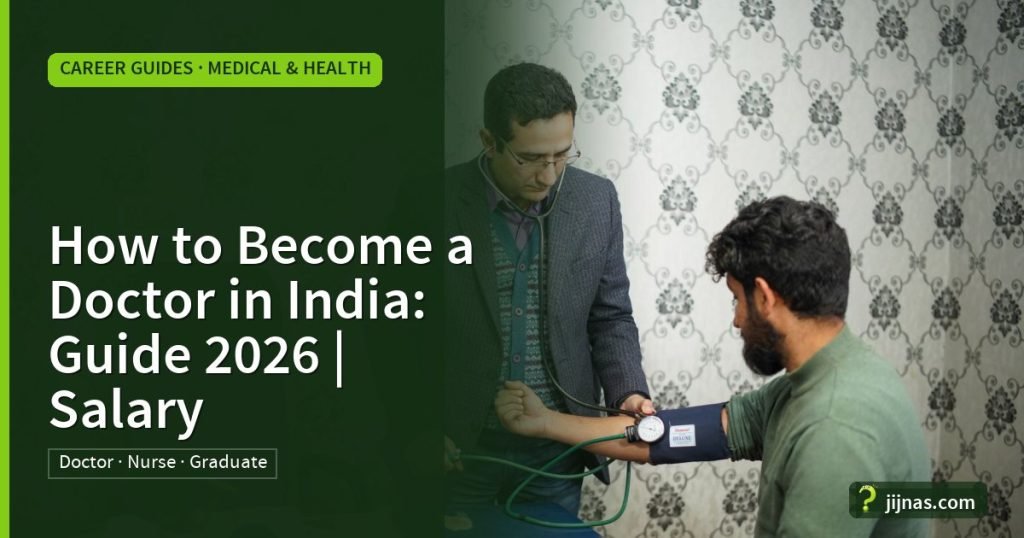
Doctors diagnose and treat illnesses, injuries, and other health conditions to improve and maintain patient well-being. They evaluate patient health, prescribe medications, order diagnostic tests, and execute clinical procedures daily.
Your day as a hospital doctor starts early at 6:00 AM. You review patient files and head to the wards by 7:00 AM for morning rounds with nursing staff. At 9:00 AM, you join department meetings to discuss critical admissions and shift handovers. By 10:00 AM, you enter the outpatient department (OPD), consulting with dozens of patients, diagnosing conditions, and prescribing treatments. Your lunch at 1:00 PM is frequently interrupted by emergency calls. In the afternoon, you perform minor procedures, complete medical records, and teach junior medical students. Evening rounds wrap up around 7:00 PM, though night calls can keep you in the hospital past 9:00 PM.
You work with tools like stethoscopes, sphygmomanometers, thermometers, otoscopes, ophthalmoscopes, and complex diagnostic equipment. You operate in hospitals, clinics, or community health centers, reporting to senior consultants, department heads, or hospital directors.
A good week brings successful patient recoveries, clear diagnostic breakthroughs, and manageable duty shifts. A bad week brings high patient pressure, sudden complications, lack of sleep, and long working hours stretching 36-48 hours continuously. You may also face physical assault from distressed patient relatives and severe resource shortages in underfunded facilities.
Hour by hour
- 6:00 AMWake up and review patient cases for the day.
- 7:00 AMArrive at the hospital, begin ward rounds, and check on admitted patients with nursing staff.
- 9:00 AMAttend morning meetings to discuss new admissions, critical cases, and shift handovers.
- 10:00 AMStart outpatient department (OPD) consultations, examine patients, and prescribe treatments.
- 1:00 PMTake a quick lunch break, often interrupted by urgent patient needs.
- 2:00 PMPerform minor procedures, continue OPD consultations, and update patient records.
- 5:00 PMTeach junior doctors or attend continuing medical education sessions.
- 7:00 PMConduct evening ward rounds and prepare plans for the next day.
- 9:00 PMFinish shift duties or stay longer for on-call emergency duty.
Who Should Choose This?
Becoming a doctor requires absolute commitment to human care, steady focus under extreme pressure, and a willingness to master vast scientific material over a long period.
You should NOT choose this path if you want quick financial returns right after school, predictable 9-to-5 working hours, a low-stress environment, or if you dislike close physical interaction with sick patients.
The Roadmap
- Class 10 Subject Selection Choose the Science stream with Physics, Chemistry, and Biology (PCB) as core subjects, along with English. Ensure your Class 10 board exam scores are high enough to secure a science seat in your school or college.
- Higher Secondary PCB Focus & NEET Preparation Master the Class 11 and 12 NCERT syllabus thoroughly for Physics, Chemistry, and Biology. Begin dedicated entrance prep to solve multiple-choice questions quickly and accurately.
- NEET UG Qualification Register for and clear the National Eligibility cum Entrance Test (NEET UG). Achieve a high percentile to qualify for medical seats across India.
- Counselling & MBBS Seat Allocation Participate in Medical Counselling Committee (MCC) or state-level counselling sessions. Secure an MBBS seat in a government or private medical college based on your NEET rank.
- Undergraduate Medical Studies (MBBS) Complete 4.5 years of academic study divided into pre-clinical, para-clinical, and clinical phases. Pass all professional examinations covering anatomy, physiology, pharmacology, pathology, and clinical medicine.
- Compulsory Rotating Internship Complete a mandatory 1-year rotating internship in an attached teaching hospital. Gain hands-on practical training across departments like medicine, surgery, pediatrics, and obstetrics.
- Medical Registration Register with the National Medical Commission (NMC) or your State Medical Council upon internship completion. You are now legally licensed to practice medicine as a general physician.
- Postgraduate Specialization (Optional) Appear for NEET PG to secure an MD (Doctor of Medicine) or MS (Master of Surgery) seat. Complete 3 years of specialized training to become a specialist consultant.
Start from where you are
The road is different from Class 9 than from a job. Pick your line; the page remembers it.
- Class 10Score well in your board exams.
Good scores help secure entry into the science stream for Class 11.
- Class 11-12Choose Physics, Chemistry, and Biology (PCB) as core subjects.
PCB is mandatory for NEET UG eligibility.
- Class 11-12Prepare for NEET UG alongside school studies.
Early preparation is crucial for this highly competitive entrance exam.
- After Class 12Appear for NEET UG.
Qualifying NEET UG is required for MBBS admission.
- After NEET UGParticipate in counselling to secure an MBBS seat.
Counselling allocates medical seats based on your exam rank.
- During MBBS (4.5 years)Complete your medical coursework and practical training.
This earns your foundational medical qualification.
- After MBBS (1 year)Complete the mandatory rotating internship.
Internships give required clinical experience across hospital departments.
Your first move this month is to build strong fundamental concepts in Science and Mathematics. Do not worry about medical entrance tricks yet. Focus on getting excellent grades in your Class 10 board exams so you easily qualify for the Science stream (PCB) in Class 11. Practice clear reading habits and basic biology diagrams. The order of things is simple: pass Class 10 board exams, enroll in Class 11 PCB, and start early NCERT-focused preparation. Expect roughly 7.5 years of effort from Class 11 to your first full job after internship. The biggest trap to avoid at this point is neglecting Class 10 Mathematics or Science, which can restrict your admission into top science streams.
- Class 11-12Master your PCB concepts and start dedicated NEET preparation.
Class 11 and 12 PCB syllabus forms the foundation for NEET UG.
- After Class 12Take the NEET UG exam.
It is the single entrance exam for MBBS in India.
- After NEET UGAttend NEET counselling for MBBS seat allocation.
This step confirms your medical college admission.
- During MBBS (4.5 years)Pass all professional academic MBBS exams.
Academic study provides essential clinical knowledge.
- After MBBS (1 year)Complete the 1-year rotating internship.
Practical hospital training is required before registration.
Your first move this month is to align your daily study schedule directly with the NCERT Class 11 and 12 Biology, Chemistry, and Physics textbooks. NEET UG questions come straight from these topics. If you are in Class 12, you can apply for NEET UG provisionally, provided you submit your passing marksheet during counselling. The order of things is to score at least 50% aggregate in PCB (40% for SC/ST/OBC), pass your Class 12 exams, clear NEET UG, and clear counselling. Expect 5.5 years from passing Class 12 to completing your MBBS and internship. The trap to avoid is ignoring Class 11 topics, as NEET covers Class 11 and Class 12 syllabi equally.
- ImmediateComplete Class 12 level Physics, Chemistry, and Biology through open school if needed.
PCB in Class 12 is mandatory for NEET UG eligibility.
- After PCB completionPrepare for and clear NEET UG.
You must qualify NEET UG regardless of prior degrees.
- After NEET UGUndergo counselling and join an MBBS program.
This begins your formal medical training.
- During MBBS (4.5 years)Complete all academic requirements of the MBBS degree.
It gives you the primary medical qualification.
- After MBBS (1 year)Finish the compulsory rotating internship.
Hands-on medical training is mandatory.
Your first move this month is to check if you completed Class 12 with Physics, Chemistry, Biology/Biotechnology, and English. If you studied non-PCB subjects in school, you must first complete your Class 12 PCB requirements through a recognized board like the National Institute of Open Schooling (NIOS) or a state open school. Once eligible, prepare for and pass NEET UG. The order of things is: clear PCB requirements, qualify NEET UG, complete 4.5 years of MBBS study, and finish the 1-year rotating internship. Expect about 6.5 years total to earn your medical license. The trap to avoid is assuming your previous degree waives the entrance exam or subject prerequisites; NEET UG is strictly mandatory for everyone.
- ImmediateFulfill Class 12 PCB eligibility through recognized boards if required.
NEET UG requires specific subject qualifications.
- After PCB eligibilityPrepare for NEET UG.
Clearing NEET UG is mandatory for MBBS admissions.
- After NEET UGJoin an MBBS program via counselling.
Full-time medical education is compulsory.
- During MBBS (4.5 years)Complete the undergraduate medical syllabus.
You need this base to practice medicine.
- After MBBS (1 year)Complete a 1-year hospital internship.
Hands-on experience prepares you for independent practice.
Your first move this month is to evaluate your academic transcripts against National Medical Commission (NMC) eligibility criteria. Ensure you have the required 50% aggregate in PCB (40% for reserved categories) in Class 12 and reach at least 17 years of age. There is no upper age limit for NEET UG, so you can apply regardless of your current age. The order of things is: prepare for NEET UG, quit full-time work upon admission (MBBS requires mandatory full-time attendance), complete the 5.5-year degree and internship, and register with the NMC. Expect roughly 6.5 years to complete the transition. The trap to avoid is attempting to maintain a corporate job while enrolled in MBBS; medical school mandates full-time physical attendance in classes and hospital wards.
Entrance Exams
To study medicine in India, one single exam controls entry to all undergraduate medical seats across government, private, deemed, and central universities. Qualifying this national test is also legally required for any Indian citizen intending to pursue an undergraduate medical degree abroad.
The exams, with your doors
- Admits to
- MBBS, BDS, and AYUSH courses
- Who can sit
- Class 12 with PCB and English. Minimum 50% aggregate in PCB for General (40% for SC/ST/OBC). Minimum 17 years age by Dec 31.
- When
- Annually in May or June
- Attempts
- No limit
- Admits to
- MD, MS, and PG Diploma courses
- Who can sit
- MBBS degree from recognized institution, valid NMC registration, and completed internship.
- When
- Annually
- Attempts
- No limit
Who can apply opens the eligibility page when this site has one for the exam. Plan opens your planner with the exam filled in; you set the date the notification gives.
Top Colleges
Government medical colleges offer highly subsidized tuition fees and very high patient volumes, making them the most sought-after choice for clinical training. Private medical colleges provide excellent infrastructure, but their tuition fees are significantly higher. Entry to both government and private institutes is governed strictly by NEET UG scores and counselling ranks.
Colleges and what they cost
- Course
- MBBS
- How to get in
- NEET UG
- Aid
- Government scholarships like Pragati and National Overseas schemes.
- Course
- MBBS
- How to get in
- NEET UG
- Aid
- Institutional financial assistance programs.
- Course
- MBBS
- How to get in
- NEET UG + AFMC selection process
- Aid
- Service obligation benefits and defense grants.
- Course
- MBBS
- How to get in
- NEET UG
- Aid
- Central and state welfare scholarships.
- Course
- MBBS
- How to get in
- NEET UG
- Aid
- Merit scholarships where eligible.
Fees are for the whole course, as published by the college; hostel and mess come on top.
Skills to Build
Foundation
Foundation skills form the academic and observational groundwork you need before stepping into direct clinical care. You build these through disciplined basic science study.
- Strong Medical Knowledge: Learn foundational human biology by mastering NCERT Class 11 and 12 Biology textbooks.
- Clinical Diagnosis Basics: Understand basic scientific concepts through the Basic Medical Sciences course on NPTEL.
- Patient Communication: Improve spoken interaction skills using the Communication Skills course on SWAYAM.
Core
Core skills enable you to handle complex patient situations, analyze lab data, and make safe clinical decisions on the ward floor.
- Critical Thinking: Build logical evaluation skills with the Effective Problem Solving course on Coursera.
- Attention to Detail: Develop systematic observational routines using online analytical skills modules on edX.
- Empathy & Patient Care: Gain real human insight by doing volunteer work in local healthcare clinics or community NGOs.
Edge
Edge skills set you apart in clinical leadership, advanced medical research, and high-stress emergency environments.
- Stress Management: Practice mental resilience through structured mindfulness workshops on SWAYAM.
- Research Methodology: Learn clinical data analysis using the Research Methodology course on NPTEL.
- Team Leadership: Build leadership capabilities by organizing student body medical camps or college societies.
The skills ladder
Tick a skill you already have. The ladder keeps your ticks on this device.
Salary Reality
During your compulsory 1-year MBBS internship, you earn a monthly stipend ranging from ₹10,000 to ₹30,000. As a fresh MBBS graduate entering work as a Junior Resident or Medical Officer, your starting package typically ranges between ₹4 LPA and ₹7.5 LPA. With 5 years of clinical experience, an MBBS doctor earns around ₹10 LPA to ₹12 LPA.
Specialization significantly increases earning potential. A specialist holding an MD or MS degree earns between ₹1,000,000 and ₹5,000,000 per month in high-demand fields like surgery or radiology as experience grows. Super-specialists holding DM or MCh degrees, particularly in fields like oncology and cardiology, earn top-tier salaries in private hospitals.
Government hospitals pay based on official scales, offering job security, pension benefits, housing, and medical allowances. Private hospitals offer higher initial pay, with experienced doctors in metro cities earning up to ₹3,00,000 per month. Major metro cities pay higher base amounts compared to smaller towns.
Telemedicine and teleconsultation platforms allow some remote consulting work, but medical practice remains overwhelmingly an in-person, physical profession. Your ultimate salary is driven by your specialization level, surgical skill, reputation, location, and hospital type.
The salary ladder, in lakh a year
Government doctors earn ₹60,000 to ₹3,00,000 per month with job security, housing, and pension benefits.
Private hospitals pay higher, with experienced doctors in metro cities earning up to ₹3,00,000 per month.
Telemedicine offers growing remote consultation options, but primary medical work requires physical presence.
What It Costs
The financial path to becoming a doctor depends entirely on whether you secure a government or private college seat. The total training cost breaks down as follows:
- NEET UG Application Fee: ₹1,000 (SC/ST/PwD/Third Gender) to ₹1,700 (General Category).
- NEET UG Coaching (Optional): ₹50,000 to ₹3,00,000.
- Government MBBS Tuition Fee: ₹5,000 to ₹1,00,000 per year (Total course fee ₹25,000 to ₹5,00,000). AIIMS colleges charge as low as ₹5,000 to ₹9,00,000 total.
- Private MBBS Tuition Fee: ₹29,700 to ₹5.50 Crore total across private medical colleges and deemed universities.
- Hostel & Living Expenses: ₹30,000 to ₹1,50,000 per year depending on city and hostel facilities.
- Books & Medical Equipment: ₹15,000 to ₹40,000 per year for diagnostic tools, medical textbooks, and aprons.
What the road costs
| NEET UG Application Fee | ₹1,000 to ₹1,700 |
| NEET UG Coaching | ₹50,000 to ₹3 lakh |
| Government MBBS Annual Tuition | ₹8,000 to ₹1 lakh |
| Private MBBS Total Tuition | ₹29,700 to ₹5.5 crore |
| Hostel and Mess Fees per year | ₹76,000 to ₹1.6 lakh |
| Whole road | ₹1.65 lakh to ₹5.56 crore |
Government medical seats are very affordable, whereas private medical seats require high financial investment.
The Years Ahead
The standard progression from medical student to senior specialist spans several distinct stages:
- Years 1-5 (MBBS & Internship): Academic learning, clinical postings, professional exams, and a 1-year rotating internship earning ₹10,000 to ₹30,000 per month.
- Years 6-8 (Junior Resident / Post-Graduation): Practicing as a Junior Resident earning ₹4-7.5 LPA, or completing a 3-year MD/MS postgraduate degree via NEET PG.
- Years 9-11 (Senior Resident / Super-Specialization): Working as a Senior Resident or pursuing DM/MCh super-specialization in cardiology, neurology, or oncology.
- Years 12+ (Consultant / Head of Department): Practicing as a Senior Consultant, establishing a private practice, or leading hospital departments earning ₹10-12+ LPA (MBBS) or ₹1,00,000-₹5,00,000+ per month (Specialist).
Could a machine take this job?
AI assists in diagnostics and imaging, but physical procedures, clinical decisions, and human empathy cannot be automated.
Specialties like oncology, neurology, and geriatrics.
Unspecialized general consultations due to automated triage tools.
Pros and Cons
Pros
- High societal respect and social prestige attached to saving lives.
- Strong job security; doctors are always in demand regardless of economic downturns.
- Diverse career choices spanning clinical practice, research, administration, and public health.
- Substantial earning potential after post-graduation and specialization.
- Opportunity to make a tangible, direct impact on human health and well-being.
Cons
- Long, grueling shifts lasting up to 36-48 hours during residency.
- High emotional stress and mental fatigue when handling critical patient outcomes.
- Risk of physical assault from distressed patient relatives in high-pressure emergency rooms.
- Long gestation period; takes at least 5.5 to 8.5 years before achieving financial stability.
- Private medical education costs can be extraordinarily expensive.
Mistakes Students Make
- Relying on Multiple Study Materials: Skipping basic NCERT textbooks in favor of complex reference books creates confusion. Focus on NCERT first for NEET UG.
- Ignoring Class 11 Topics: Postponing Class 11 revision until the final months leads to poor ranks because NEET UG covers Class 11 and 12 equally.
- Neglecting Physical and Mental Health: Skipping meals and sleeping inadequately damages long-term exam performance and causes burnout during residency.
- Underestimating Competition: Assuming high Class 12 board marks guarantee success without rigorous multiple-choice practice.
- Not Preparing for Workload Reality: Entering medical school expecting quick money without understanding the brutal 36-48 hour duty shifts.
The mistakes, and the fix
✓ Study Class 11 and 12 PCB equally, as NEET tests both years.
✓ Calculate total 5.5-year expenses including hostel fees before counselling.
✓ Prepare for intense 36-48 hour duty shifts during residency.
✓ Register promptly with the NMC or State Council to practice legally.
Plan B
If you choose not to pursue MBBS or wish to consider alternate careers in healthcare and life sciences, here are four practical non-MBBS alternatives:
- BDS (Bachelor of Dental Surgery): 5-year undergraduate program focusing on dental care, oral surgery, and orthodontics. Entry is through NEET UG.
- BAMS / BHMS / BUMS (AYUSH Courses): 5.5-year degrees in traditional medical systems like Ayurveda, Homeopathy, or Unani. Entry is through NEET UG.
- B.Sc Nursing / Allied Health Sciences: 3-to-4-year degrees in Nursing, Radiotherapy, Medical Laboratory Technology, or Anesthesia Technology with strong hospital employment opportunities.
- B.Pharm / Biotechnology: 4-year technical degrees leading to careers in pharmaceutical manufacturing, drug research, medical writing, and clinical trials.
FAQs
Is NEET UG mandatory for studying medicine abroad?
Yes. Qualifying NEET UG is legally mandatory for any Indian citizen or Overseas Citizen of India (OCI) intending to pursue an undergraduate medical course in any foreign medical institute.
What is the minimum age to appear for NEET UG 2026?
Candidates must be at least 17 years old at the time of admission or must turn 17 on or before December 31st of the admission year.
Is there an upper age limit for NEET UG?
No. As per current National Medical Commission (NMC) guidelines, there is no upper age limit for taking the NEET UG exam.
Can open school students (NIOS) apply for NEET UG 2026?
Yes. Students from the National Institute of Open Schooling (NIOS) or state open schools are eligible for NEET UG provided they studied Physics, Chemistry, and Biology/Biotechnology in Class 12.
How long does it take to become a specialist doctor in India?
It takes 5.5 years for MBBS (including a 1-year internship), followed by 3 years for an MD/MS degree, totaling 8.5 years of study and clinical practice.
🕐 Your Step-by-Step Pathway to Becoming a Medical Doctor in India
- Complete Class 12 with PCB2 years
Study Physics, Chemistry, Biology/Biotechnology, and English as core subjects in Class 12. Secure at least 50% aggregate in PCB for General category or 40% for reserved categories.
- Qualify for NEET UGExam day
Appear for the single national level offline entrance exam covering Physics, Chemistry, and Biology (3 hours 20 minutes duration).
- Complete Academic MBBS Studies4.5 years
Undergo 4.5 years of formal medical academic coursework covering preclinical, paraclinical, and clinical subjects.
- Mandatory Rotating Internship1 year
Complete 1 year of compulsory rotating medical internship across clinical departments with monthly stipends ranging from Rs 10,000 to Rs 30,000.
- Postgraduate Specialization (MD/MS)3 years
Qualify through NEET PG to pursue a 3 year specialization in fields like General Surgery, Pediatrics, Internal Medicine, or Radiology.
- Super Specialization (DM/MCh)3 years
Optional advanced sub-specialization in advanced domains like Cardiology, Neurosurgery, or Oncology.
⚖️ Comparing Government and Private Medical Colleges in India
| Government Medical Colleges | Private Medical Colleges | |
|---|---|---|
| Annual Tuition Fees | Rs 8,000 to Rs 1 lakh+ per year (AIIMS Delhi charges Rs 5,000-7,000 total) | Rs 29.7 thousand to Rs 5.50 crore total course cost |
| Top Institutions | AIIMS New Delhi, JIPMER Puducherry, MAMC New Delhi, AFMC Pune | CMC Vellore, KMC Manipal, St. John's Bengaluru, JSS Mysore |
| Patient Volume & Clinical Exposure | Exceptionally heavy patient load offering extensive hands-on experience | Varies by institute, generally moderate patient flow compared to state hospitals |
| Admission Competition | Extremely high cut-off scores due to subsidized fees and prestige | High cut-offs for government seats, flexible entry via management/NRI quotas |
🎯 Government colleges offer superior clinical exposure at a fraction of the cost, making them the primary choice for aspirants.
🧭 Check Your Eligibility for NEET UG Admission
Answer each question, get to the fix. Take the same path you would at the bench.
See the whole map at once
- Are you studying or completed Class 12 with Physics, Chemistry, Biology/Biotechnology, and English?YesNo
- Will you complete 17 years of age on or before December 31st of the admission year?YesNo
- Select your reservation category to verify required Class 12 PCB aggregate marks:GeneralSC / ST / OBC (NCL)PwBD
- Do you have at least 50% aggregate marks in Physics, Chemistry, and Biology in Class 12?YesNo
- Do you have at least 40% aggregate marks in Physics, Chemistry, and Biology in Class 12?YesNo
- Do you have at least 40% (or 45% for General PwBD) aggregate marks in PCB in Class 12?YesNo
- You fulfill age, subject, and marks requirements set by NMC guidelines. → Eligible to apply for NEET UG
- Physics, Chemistry, Biology/Biotechnology, and English are mandatory qualifying subjects. → Not Eligible
- Candidates must turn at least 17 years old within the admission calendar year. → Not Eligible for current year
- Your PCB aggregate score falls below the required threshold for your category. → Not Eligible
🔍 Debunking Common Myths About Medical Education in India
MythThere is a strict upper age limit and attempt cap for taking NEET UG.
RealityUnder current NMC rules, there is no upper age limit and no restriction on the number of attempts for NEET UG.
MythStudents passing Class 12 from open schooling like NIOS cannot sit for NEET.
RealityCandidates from open schools (NIOS/State Open Schools) are eligible provided they studied Physics, Chemistry, and Biology/Biotechnology.
MythStudying medicine always requires tens of lakhs in college fees.
RealityGovernment institutes like AIIMS Delhi charge total course fees between Rs 5,000 to Rs 7,000 for the full 5.5 year MBBS degree.
MythCompleting an MBBS degree guarantees immediate high earnings and light schedules.
RealityFresh MBBS graduates typically start around Rs 4-7.5 lakhs annually and resident doctors frequently work demanding shifts up to 36-48 hours.
Your decision notebook
Two lines now save you a wrong year later. Everything stays on this device.
Other roads from here
 Any streamBusiness & FinanceHow to Become a Management Consultant in India: 2026 GuideLearn how to become a management consultant in India. Explore degrees, top colleges, case interviews, salaries, and career growth in this 2026…CATXATGMATNMATStarts at₹6-200 LPA
 Any streamEngineering & TechHow to Become a Data Analyst: 2026 Guide | Salary & PathLearn how to become a Data Analyst in India. Explore 2026 career roadmap, required skills, salary trends, top colleges, and future outlook.
 Any streamBusiness & FinanceHow to Become an MBA Professional: Guide | Salary, ExamsLearn how to pursue an MBA in India. Discover entrance exams, top colleges, admission steps, and salary expectations in this practical guide.CATXATCMATNMATStarts at₹5-60 LPA
 Any streamEmerging CareersHow to Become a Product Manager in India: 2026 GuideLearn how to become a Product Manager in India. Check the 2026 roadmap, entry paths, salary expectations, required skills, and top courses.CATXATGMATNMAT by GMACStarts at₹8-300 LPA